Dressing-Light Accuracy at Floor Mirrors: Color Fidelity, CCT, and Vertical Illuminance
A bright floor mirror can still make a navy jacket look black or cast uneven facial shadows. Reliable dressing light depends on how much light reaches the standing occupant, how evenly it arrives, and how accurately it renders color.
- Measure vertical illuminance on the occupant.
- Set maintained output and uniformity criteria.
- Specify CCT and color-rendering data separately.
- Choose fixture geometry from photometry.
- Account for finishes and daylight.
- Verify submittals and commission the installation.
Why is vertical illuminance the controlling metric at floor mirrors?
Vertical illuminance on the standing person is the controlling measurement because skin and clothing must receive light before the mirror can reflect useful information. Fixture lumens, floor illuminance, and light striking the glass are poor substitutes.
The standing occupant, not the mirror glass, is the lighting task surface
A glowing mirror border may create glare while delivering little light to the face, torso, or trousers. Integrated LEDs work as dressing light only when their distribution projects sufficient light toward the user. LED efficiency and longevity, as described by ENERGY STAR, do not predict occupant-plane illuminance.
How should vertical illuminance at a floor mirror be measured?
Place a calibrated, cosine-corrected illuminance meter at the normal standing position. Hold the sensor vertically, facing the mirror and luminaires, and measure at face, upper-torso, waist, and lower-garment heights. Record standing distance, daylight conditions, dimmer settings, and whether output is initial or maintained.
Floor mirrors need a target range and uniformity criterion, not a lumen guess
Specify maintained vertical illuminance and acceptable uniformity across the occupant. Project values should come from applicable current IES or CIE guidance and measured photometry, not an unsupported universal threshold.
Fixture lumens cannot predict lighting performance at floor mirrors
Fixture lumens describe total emitted light, not how much reaches a person. Performance changes with optics, shielding, mounting distance, orientation, surface reflectance, dirt, and aging. A narrow beam may light the head while missing the torso and lower garments.
Model the actual room using manufacturer photometric files, realistic reflectances, and proposed fixture positions. Specify maintained performance so depreciation does not push the installation below its acceptance range.
Uniform light across the face and clothing matters alongside average illuminance
An acceptable average can conceal dark eye sockets, an overbright forehead, or poorly illuminated trousers. Record minimum, average, and maximum readings using the same sensor orientation and standing position. Inspect shadows caused by ceiling downlights, side lights, and the occupant’s body.
Which CCT and color-fidelity metrics make floor-mirror colors dependable?
Dependable color requires spectral information, not CCT alone. Use CCT for the apparent warm-to-cool setting, CRI Ra as an initial screen, and current ANSI/IES TM-30 data to compare fidelity, gamut, and hue-specific shifts.
CCT changes appearance and adaptation but does not measure color accuracy
Correlated color temperature, expressed in kelvin, identifies the Planckian radiator whose perceived color most closely resembles a source. Two LEDs can have the same CCT but different spectral power distributions, causing reds, blues, greens, skin, and neutral fabrics to appear differently.
Select CCT for the room and time of use. A warm evening bedroom and a daylight-adjacent dressing area may need different scenes. Allow visual adaptation before judging fabrics after moving between daylight and warm electric light.
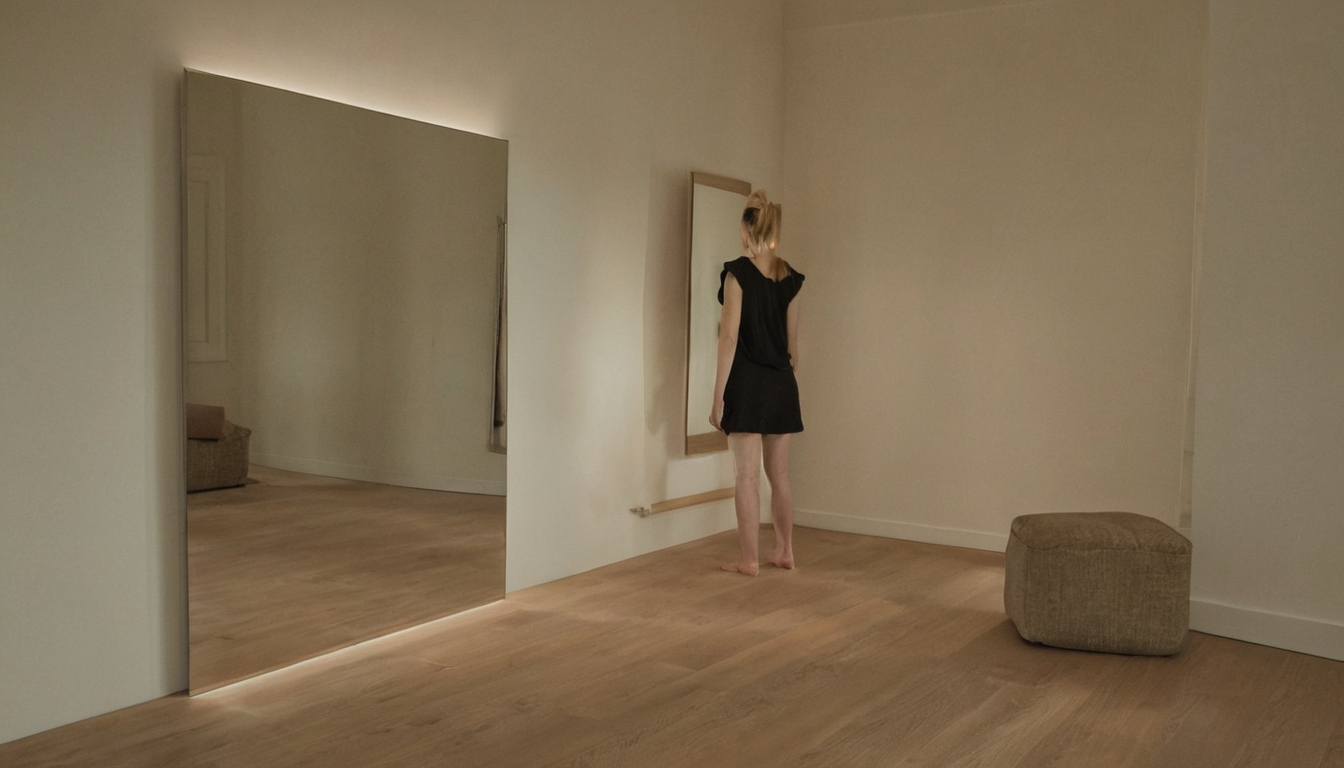
Which CCT and color-fidelity metrics make floor-mirror colors dependable shown with practical context cues.
TM-30 reveals color shifts that CRI can conceal
CRI Ra averages eight relatively low-saturation test colors and excludes saturated red sample R9. Request R9 when skin, red textiles, cosmetics, or warm timber matter. Equal CRI and CCT values do not establish equal color rendering.
TM-30 provides a broader diagnosis: Rf describes average fidelity, Rg describes average saturation change, and hue-angle graphics show where color families gain or lose chroma or shift hue. Review all three. The IES Lighting Library provides current ANSI-approved lighting standards; confirm the applicable TM-30 edition during specification.
Tunable-white floor-mirror lighting requires spectral data at every intended setting
Request reports at warm, middle, and cool settings and representative dimmed levels. Each should identify CCT, output, CRI Ra, R9, TM-30 Rf, Rg, and hue graphics because channel mixing can alter brightness, chromaticity, and fidelity. Confirm whether dimming and CCT controls operate independently or follow a fixed curve.
Side lighting usually gives floor mirrors a better starting geometry than ceiling-only light
Side or near-vertical lighting is usually the first layout worth testing because it can illuminate the face and clothing with fewer downward shadows. Final selection still depends on occupant-plane photometry, glare, wiring, dimming, and service access.
- Compare layouts using the same occupant position, mirror angle, reflectances, and maintained target.
- Request photometric files and candela distributions.
- Check direct glare and reflected images of bright sources.
Paired vertical luminaires can reduce facial and torso shadows at floor mirrors
Paired luminaires can provide balanced facial modeling. Select diffused or shielded sources with enough illuminated height for expected users, and position them to send light toward the person rather than across the glass. Check one-sided layouts for asymmetric shadows and low illumination on the opposite side.
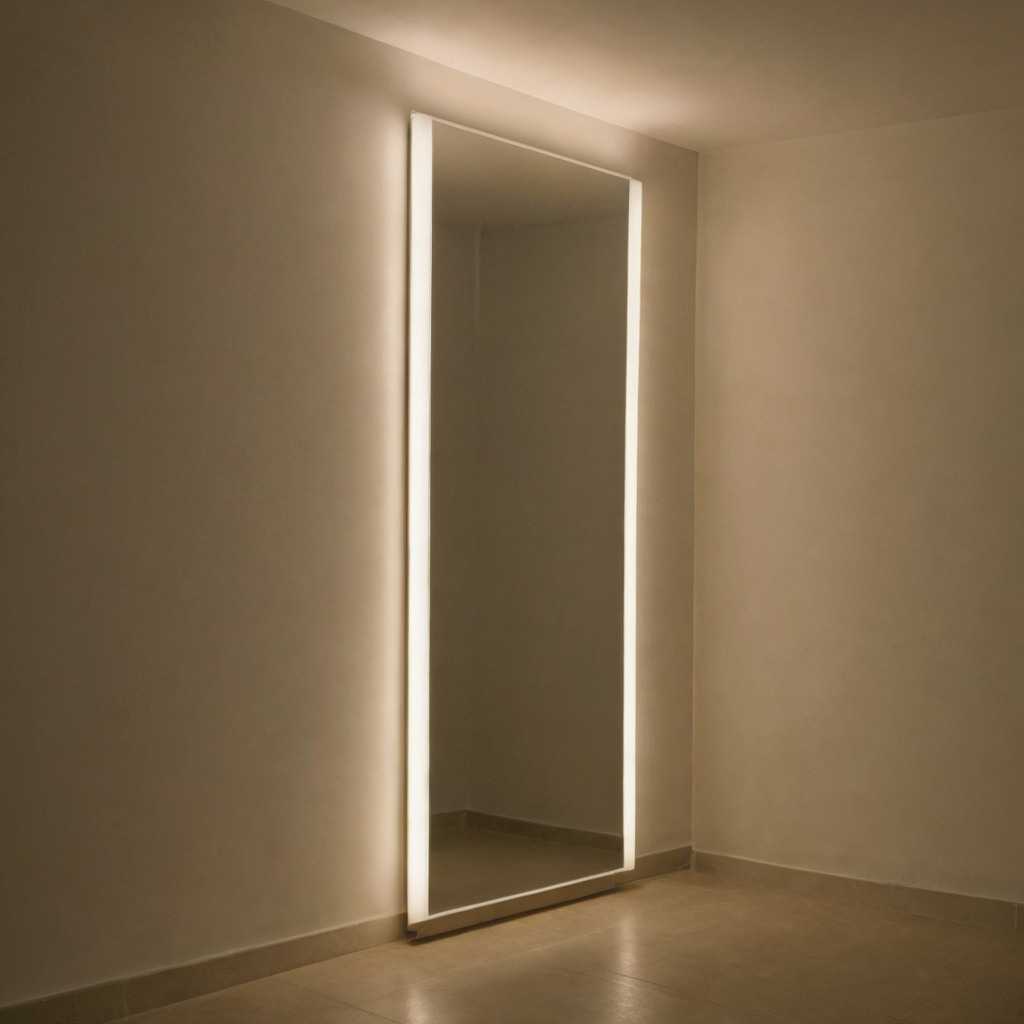
Side lighting usually gives floor mirrors a better starting geometry than ceiling-only light shown as an editorial planning reference.
Ceiling luminaires at floor mirrors must be aimed and positioned for the occupant plane
Adjustable ceiling fixtures can work where wall wiring is impractical. Beam angle, setback, ceiling height, cutoff, and aiming must place useful light on the person without creating dark eye sockets, torso shadows, or a bright reflection. Coordinate lighting with floor-mirror placement, viewing angles, and anchoring.
Mirror-integrated LEDs need verified output beyond the glowing border
Treat integrated LEDs as luminaires, not decoration. Require outward photometry, readings at realistic standing distances, dimming data, accessible drivers, replaceability information, warranty terms, safety certification, and confirmation of local electrical requirements.
Room finishes and mixed daylight can undermine floor-mirror color accuracy
Strong surface colors, dark finishes, and changing daylight can distort mirror judgments even when luminaires have good laboratory metrics. Assess the finished room under normal dressing conditions.
Strongly colored surfaces can contaminate the light reaching a floor mirror user
Saturated curtains, rugs, walls, and timber wardrobes can return colored light to skin and garments. Dark finishes absorb light and may deepen lower-body shadows.
- Inspect finishes beside and behind the standing position.
- Use neutral reference samples when comparing clothing or skin tones.
- Increase direct light when colored surfaces cannot change, while controlling glare.
Mixed daylight and electric light require separate floor-mirror scenes
Window direction, cloud cover, season, and shade position alter vertical illuminance and apparent color. Commission daytime, mixed-light, evening, and blackout-shade scenes. Test consistent fabric and skin-tone references at typical dressing times, recording shade position and dimming level. Daylight-responsive dimming can stabilize brightness, but matching CCT does not guarantee matching spectra.
A floor-mirror lighting specification should end with procurement and field verification
The specification is complete only when buyers can verify the submitted product and the project team can measure the installed result. Connect spectral reports, photometry, controls, and service requirements to defined acceptance conditions.
What should buyers request before ordering floor-mirror lighting?
- CCT tolerance, CRI Ra, R9, TM-30 Rf and Rg, and hue graphics at specified settings.
- Delivered lumens, distribution data, and an IES or equivalent photometric file.
- Dimming protocol, compatible controls, minimum stable output, dimming curve, and flicker reporting.
- Driver access, replaceable parts, warranty, safety certification, and lead time.
Budget comparisons should distinguish lamp replacements and plug-in retrofits from new wall wiring or integrated mirrors because substitutions can alter photometry, control compatibility, and repair costs.
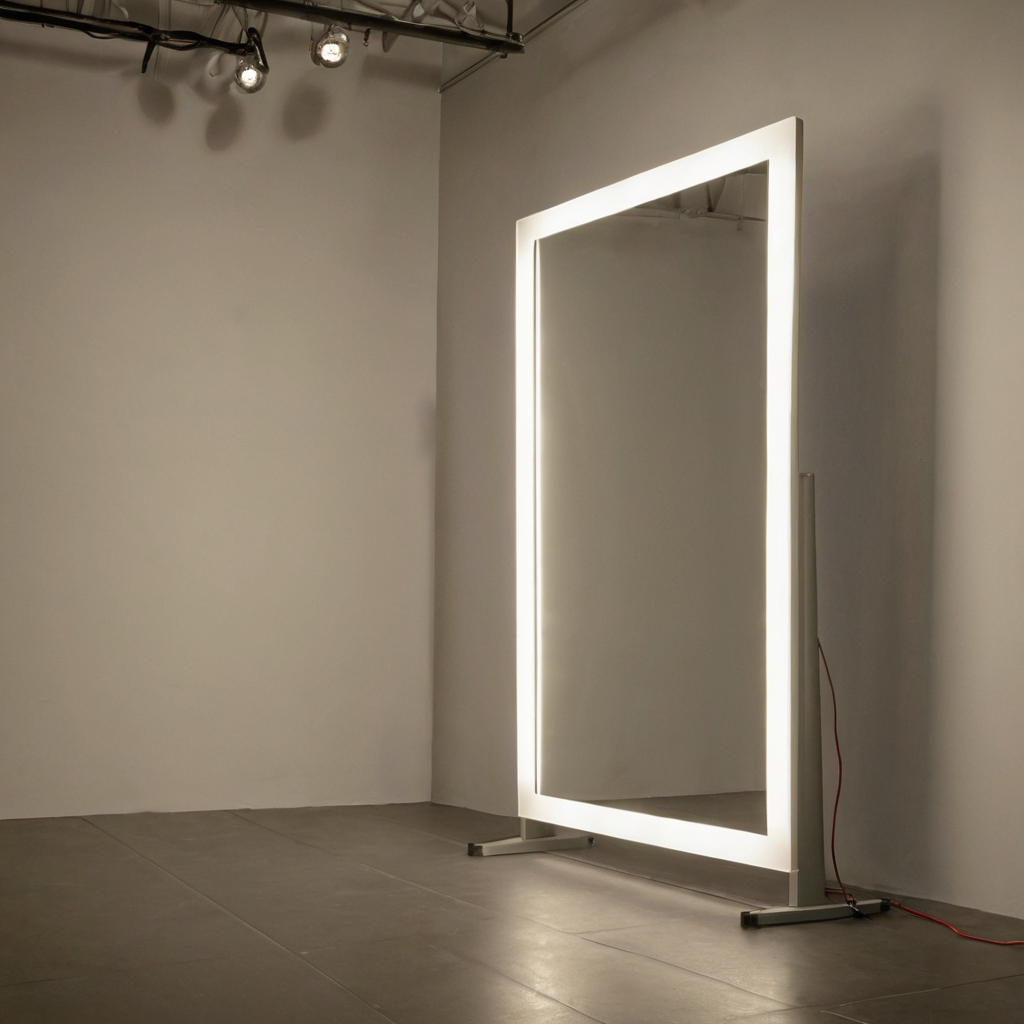
A floor-mirror lighting specification should end with procurement and field verification shown as an editorial planning reference.
How should installed floor-mirror lighting be commissioned?
Test after room finishes are installed. Exclude daylight for the electric-only test, document controls, and measure vertically at face, torso, waist, and lower-garment heights. Compare minimum, average, and maximum values with the maintained target and uniformity criterion. Repeat under planned daytime and evening scenes.
Correct failures by adjusting aiming, rebalancing dimming, changing optics or diffusers, adding side light, or modifying problematic reflective surfaces. Accept the installation only after meter readings and controlled visual checks pass.
Floor-mirror lighting acceptance-test FAQ
How many lumens are needed for lighting a full-length floor mirror?
No universal fixture-lumen value predicts performance. Specify maintained vertical illuminance and uniformity at the occupant, then verify the optics and layout through photometry and field measurement.
What CCT makes clothing and skin tones look most reliable in a floor mirror?
CCT should suit the room, daylight context, and normal dressing time. Review CRI, R9, and TM-30 data rather than selecting by kelvin alone.
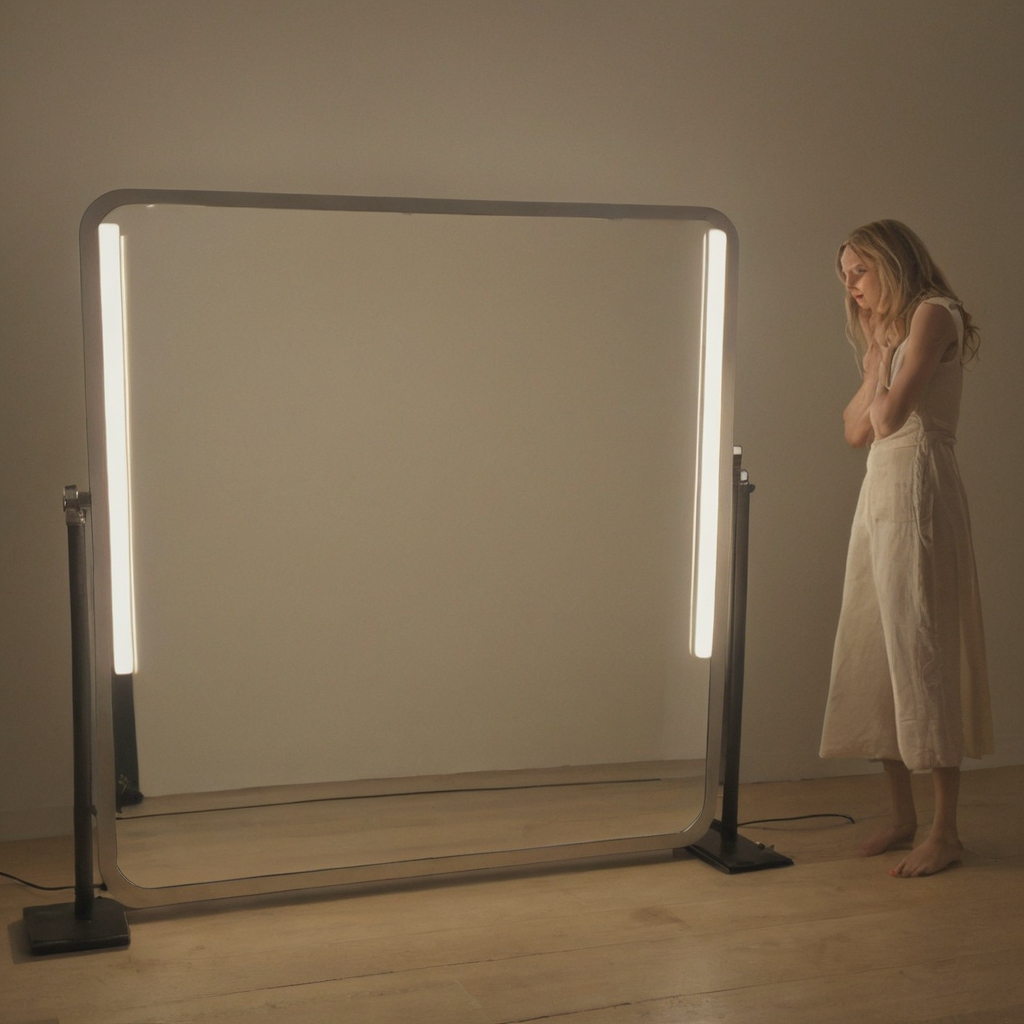
Floor-mirror lighting acceptance-test FAQ shown as an editorial planning reference.
Is high CRI sufficient, or should floor-mirror lighting include TM-30 data?
High CRI is a useful screen but is not sufficient. Request TM-30 Rf, Rg, and hue-shift graphics to identify fidelity, saturation, and color-family distortions that Ra can conceal.
Should vertical lights match the height or width of a floor mirror?
Fixture dimensions should follow the user range and photometric distribution, not mirror dimensions alone. Verify that useful light reaches the face, torso, waist, and lower garments without excessive glare.
How high and how far from a floor mirror should side or ceiling lights be installed?
No single offset suits every beam, ceiling height, mirror angle, or standing distance. Model the geometry, coordinate wiring with mirror placement, and make final aiming adjustments from occupant-plane measurements.